Everybody in their life has to accept the fact that there is a funeral ceremony that will take place. Not a wedding, not a graduation, not a housewarming — those are optional. Antyeshti, the last sanskaar, is the only one with a guaranteed RSVP.
We attend the funerals of others as if we were spectators. We are not. We are simply earlier in the queue.
The Sixteenth Sanskaar
Hindu tradition lists sixteen sanskaars — sacraments that mark the journey of a life. They begin before birth, with Garbhadhana, and continue through naming, the first solid food, the first haircut, the sacred thread, marriage. Each one is a small ceremony around a threshold: a doorway between one phase of being and the next.
Antyeshti — literally, “the last sacrifice” — is the sixteenth and final one. Anta means end. Ishti means a sacrificial offering. The body itself becomes the offering.
It is the only sanskaar performed for a person rather than by them. Every other ceremony, you are present and aware. This one, you have already left the room.
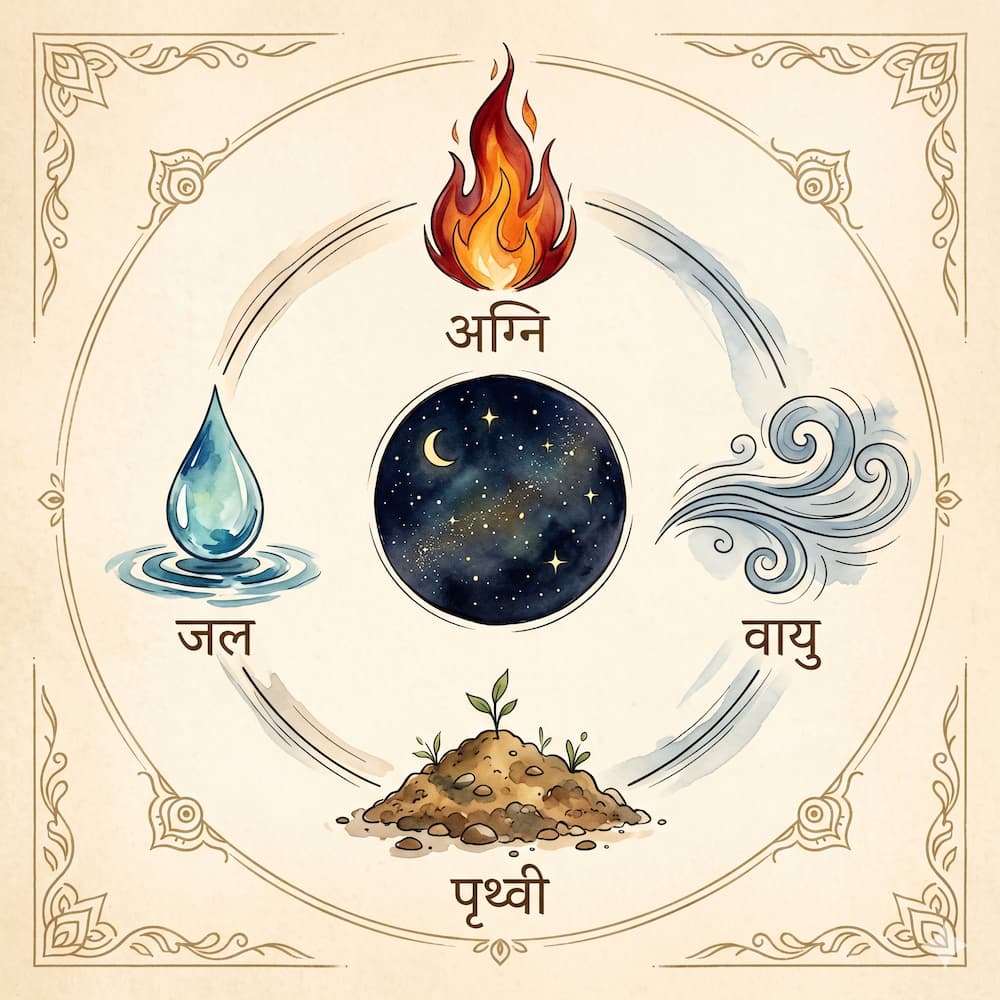
The Five Elements Going Home
The philosophy underneath antyeshti is simple and old. The body is made of five elements — prithvi (earth), jal (water), agni (fire), vayu (air), and akasha (ether). In life, they hold together as a person. In death, they are returned.
Cremation is not destruction. It is a hand-back. Fire releases heat (agni) and air (vayu). The ashes go to a river, returning to water (jal) and earth (prithvi). What remains — the atman, the self — is said to belong to akasha, the space that was never really borrowed in the first place.
Read this way, the ceremony is not morbid. It is an accounting.
What Actually Happens
The rituals vary by region, sect, and family, but the shape is consistent:
- Preparation of the body — bathing, anointing, dressing in clean cloth.
- The procession — the body is carried to the cremation ground, often by close family on foot, with chants of Ram Naam Satya Hai — “The name of Ram is the truth.”
- Mukhagni — the lighting of the pyre, traditionally by the eldest son, but increasingly by daughters, spouses, or whoever the family chooses.
- Asthi visarjan — the collected ashes and bone fragments are immersed in a flowing river, ideally the Ganga.
- The thirteen days — a period of mourning, simple food, and shraddha rites, ending with a community meal.
Each step has a purpose. The procession on foot is so the family walks the last walk together. The mantras are so the ears that may still be listening hear something familiar. The thirteen days are so grief has a container — a beginning, a middle, and a clear end.
What the Living Take From It
Western funerals, in my observation, tend to emphasize the deceased — their photograph, their accomplishments, eulogies. Antyeshti is structured differently. The deceased is barely the focus by the second day. The ceremony quickly turns toward the living: the family, the community, the obligation to keep going.
This is not coldness. It is a teaching. The dead do not need anything. The living need to remember how to be alive after a piece of their world has gone missing.
The thirteen days are a slow return. You eat plain food. You sit on the floor. You see relatives you haven’t seen in years. You are reminded — by ritual, not by lecture — that you are still here, that there is still a household to run, that grief has its season but life does not pause indefinitely.
Why It Matters Even If You Don’t Believe Any of It
You don’t have to accept reincarnation, or the five elements, or the metaphysics, for antyeshti to do its work. The ceremony is a piece of cultural technology developed over thousands of years to handle the single hardest event a family will face. It gives people something to do when there is nothing to do. It gives the body a dignified exit. It puts a frame around the unframable.
That is not nothing. In a world increasingly unsure of how to die, or how to grieve, or what to say at a graveside, antyeshti is a reminder that older traditions had answers — not perfect ones, but answers shaped by many generations of practice.
A Personal Note
Most of us will be on both sides of this ceremony. We will perform it for parents, perhaps for siblings or partners. And one day, others will perform it for us.
Knowing this in advance is not depressing. It is clarifying. The sixteenth sanskaar is the deadline that gives the previous fifteen their weight. Every other ceremony in a Hindu life — the naming, the wedding, the first grain of rice — is a small protest against the inevitability of the last one. And every one of them is more meaningful because of it.
Antyeshti is the only ceremony you cannot prepare for in person. But you can prepare for it by living the kind of life that, when it ends, leaves the people performing the rites with something more than grief — gratitude, a few good stories, and the sense that the elements you were borrowing were used well.