Each year, the arrival of the indentured labourers in Mauritius is commemorated at a national level on 2nd November at the Aapravasi Ghat site where more than 400,000 indentured labourers took their first steps on Mauritian soil between 1849 and 1924. After all, the Aapravasi Ghat is the most important indenture site in our country which is intimately linked with the history of the indentured labourers and their descendants.
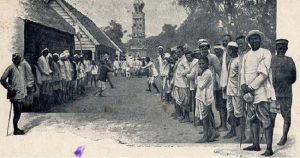
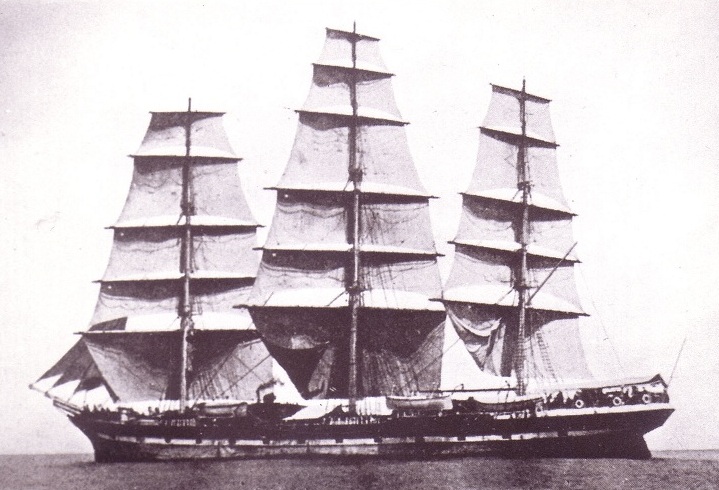
On Sunday afternoon, 2nd November 1834, after a long voyage of more than six weeks from Calcutta, the Atlas sailed into Port Louis harbour. On board, there were around 36 Hill Coolies of the Dhangar tribe from Bihar in eastern India. These indentured labourers were introduced by George Arbuthnot, who represented Hunter-Arbuthnot & Company, a British company based in Mauritius. Since it was a Sunday, Arbuthnot had to wait until the following day before starting the official formalities in order for his labourers to be landed. On Monday morning, 3rd November, Arbuthnot, wrote an official letter, on behalf of Hunter-Arbuthnot & Company, to Governor Nicolay, to request that: they be allowed to land 36 Hill Coolies from the ship Atlas, whom they intend to employ on their estate, under guarantee that they shall not become a charge on the Colony. Hunter-Arbuthnot & Company provided Governor Nicolay with a financial guarantee which was kept in trust by the local colonial government in the Colonial Treasury and would be returned after the five-year contract of the labourers had expired. During the afternoon of 3rd November, permission for the landing of the labourers was given by the British governor. It was only on Tuesday morning, 4th November, that the 36 Hill Coolies were landed close to His Majesty’s Customs House, located today next to the Port Louis Waterfront and not far from the Aapravasi Ghat.
Later that same day, Arbuthnot’s coolies were taken to Belle Alliance Sugar Estate near present-day Piton in Rivière-du-Rempart. It is interesting to note that they worked side by side with the slaves in the sugarcane fields. Each year, on 2nd November, it is the arrival of Arbuthnot’s coolies which is commemorated at the Aapravasi Ghat. However, Arbuthnot’s coolies as well as the 25,000 indentured labourers who were introduced after them between 1835 and 1839 were certainly not the first indentured labourers to set foot on Mauritian soil during the early period of British rule. ● The Experiment of 1829 In 1828, a handful of Indian workers were brought to the island. Early the following year, commercial agents of Gaillardon & Company, a Mauritian trading company, went to India with the objective of importing cheap Indian labour. Their recruitment met with some success. On 21st September, the ship The Albion dropped anchor in Port Louis harbour with 500 male labourers, 9 females, and one child on board. Within less than a month, around 600 additional labourers were imported into the colony in small batches. By the end of October 1829, there were over 1100 Indian indentured labourers in Mauritius. Unfortunately, this important labour experiment quickly turned out to be a dismal failure. A few weeks after their arrival, the sugar planters did not honour the agreements which they had made with their labourers.
Between 1826 and 1830, around 3,012 Indian workers were introduced from the French colonies of Pondicherry and Karikal, thus Reunion had a head start of several years on Mauritius.
Like every year this the 183rd Anniversary will be celebrated on Wednesday 02 of November 2017.