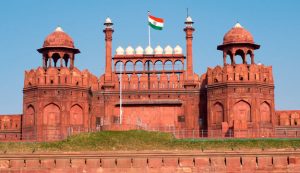
Independence Day is annually observed on 15 August with great happiness, as a national holiday in India commemorating the nation’s independence from the United Kingdom on 15 August 1947, the UK Parliament passed the Indian Independence Act 1947 transferring legislative sovereignty to the Indian Constituent Assembly. India still retained King George VI as head of state until its transition to full republican constitution. India attained independence following the Independence Movement noted for largely nonviolent resistance and civil disobedience led by the Indian National Congress (INC). Independence coincided with the partition of India, in which the British India was divided along religious lines into the Dominions of India and Pakistan; the partition was accompanied by violent riots and mass casualties, and the displacement of nearly 15 million people due to religious violence. On 15 August 1947, the Prime Minister, Jawaharlal Nehru raised the Indian national flag above the Lahori Gate of the Red Fort in Delhi. On each subsequent Independence Day, the prime minister customarily raises the flag and gives an address to the nation.
The holiday is observed throughout India with flag-hoisting ceremonies, parades and cultural events. There is a national holiday, and schools and government offices distribute sweets, but no official work is done.
How is Indian Independence Day celebrated?
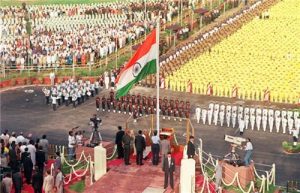
On August 15, Prime Minister Narendra Modi hoists the Indian flag on the historical site of the Red Fort in Delhi.
Special military units then fire twenty-one gunshots in honour of the sombre occasion.
The Prime Minster then pays tribute to the Indian Independence movement and highlights India’s achievements over the past year.
The Indian diaspora celebrate Indian Independence Day around the world with similar flag hoisting ceremonies, parades and pageants.
In places with higher concentrations of Indian Immigrants such as the UK and US, August 15 has become known as “India Day”.
What was the background to Indian Independence?
After World War II, the Labour government in the UK realised that with coffers exhausted, and without backing at home or abroad, it could not continue to maintain India as a British colony.
It was in February 1947 that Prime Minister Clement Atlee announced that the British government would grant India its independence and self-governance by June 1948 at the latest.
The British announced on June 3 that British India would be partitioned into two states– India and Pakistan – on August 15, 1947.
The decision was made to limit violence and bloodshed between Hindus and Muslims and the two nations were to be split along religious lines.
However, it was not successful, with the partition causing mass riots and millions of people uprooting their lives to be in perceived safer territory and to live with those of the same religion.